
Storage · Battery storage
Battery storage for commercial and industrial sites
A battery has to fit your business: your load profile, your PV generation and your grid connection. We size it from your consumption data, supply it, install it, connect it and look after its operation.
What a battery does for your business
Cap load peaks
The battery covers short power peaks from its own reserve. Where demand is metered, this lowers the peak on which the capacity charge in the network tariff is based. More on peak shaving
Use your own solar power
Whatever the PV system generates at midday beyond what the site needs at that moment is stored and consumed on site later, instead of being fed into the grid for a few cents.
Cheap and negative-price hours
With a dynamic electricity tariff, the battery can charge during hours with low wholesale prices. For PV systems commissioned since 25 February 2025, feed-in support generally lapses while prices are negative (Section 51 of the German Renewable Energy Sources Act, EEG); on a site with its own consumption, the battery absorbs this power.
When a battery pays off
In practice, mainly when three things come together:
- High electricity purchase price – every kilowatt-hour you use yourself replaces expensive grid supply.
- Daytime consumption – a large share of the solar power can be used on site.
- Pronounced load peaks – machines, cooling or charging points starting up at the same time.
Typical examples are cold stores, logistics with an electric fleet, bakeries, laundries, commercial kitchens and metalworking. At a feed-in-only plant without on-site consumption, on the other hand, the biggest lever is usually missing. If your profile does not fit, we tell you before we quote.
Battery and PV system
Combined with a PV system, the metering concept decides whether the battery may charge only solar power or grid power as well – and therefore whether the PV system keeps its feed-in support. Storage + PV
Larger systems on the medium-voltage grid
Larger batteries are often connected at medium voltage. Then the transformer, protection systems and the grid connection procedure matter as much as the battery itself. We design and build the system on a turnkey basis through to handover.
LFP technology with direct manufacturer access
Lithium iron phosphate batteries in cabinet or container format. We agree design, integration and commissioning directly with the manufacturer’s engineering team, which keeps technical communication short.
Low-voltage or medium-voltage connection
Depending on the power rating, connected to the low-voltage grid under VDE-AR-N 4105 or to the medium-voltage grid under VDE-AR-N 4110, with transformer, protection systems and the certificates the network operator requires.
Protection and secondary systems
We design and test the protection concept, telecontrol and SCADA systems as part of the project. The experience comes from transmission system operators’ substations.
Project experience at 66 kV and 220 kV substations, including the complete protection and secondary systems.
Switching authorisation for medium-voltage installations, with assignments in Germany and abroad; switching is always carried out within the plant operator’s own authorisation framework.
Most recently we worked for 50Hertz Offshore GmbH in a substation of an offshore grid connection. References
Battery systems and manufacturers
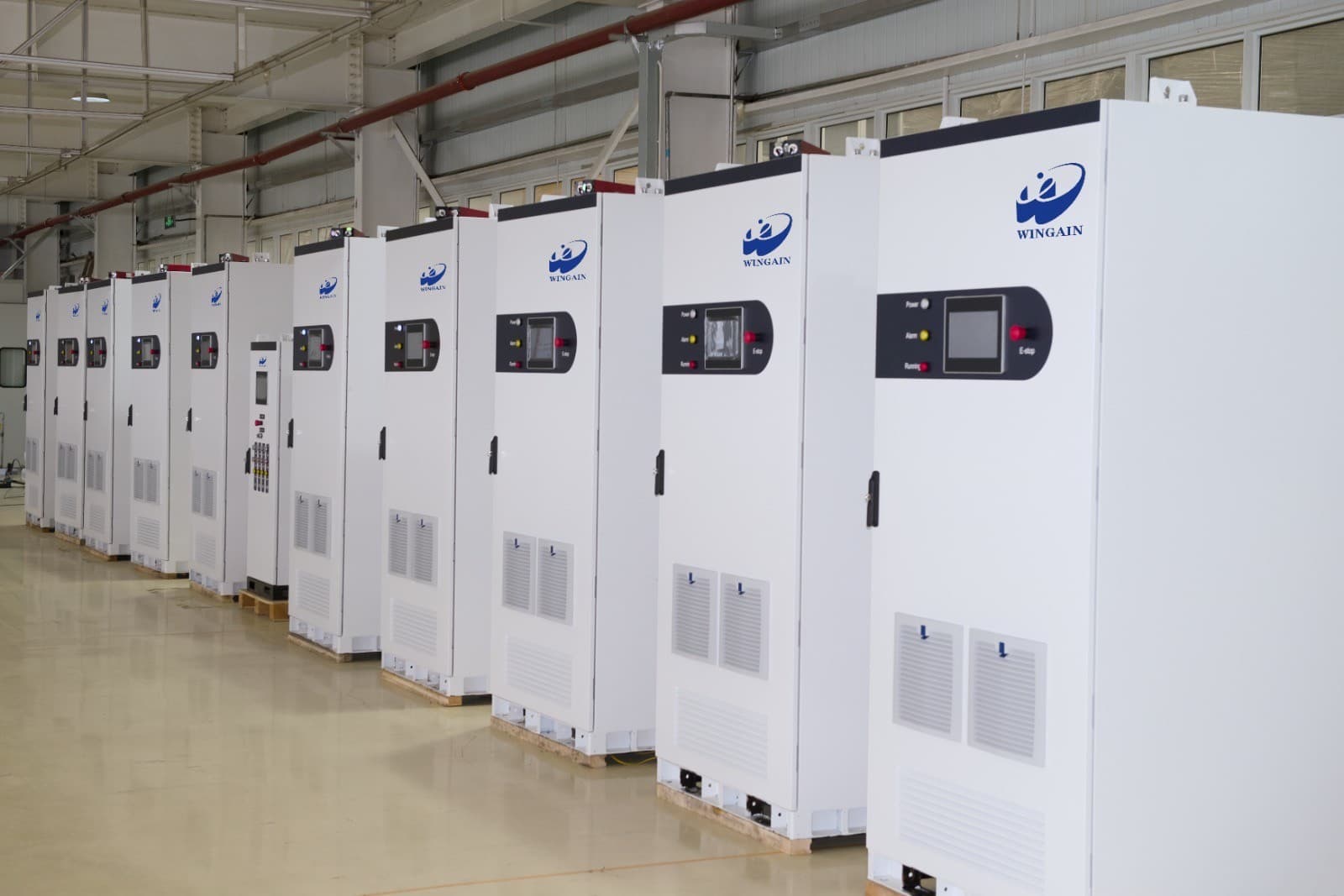
For commercial and industrial storage we work with battery systems from Wingain, among others: air-cooled and liquid-cooled cabinets with LFP cells that can be combined into larger capacities. Which system suits your business is decided by your load profile, installation location and grid connection.
In January 2025 our Managing Director travelled to Shanghai to see manufacturers’ production lines and a battery storage park in operation. Since then we have had a direct line to the manufacturers and their suppliers. For questions about components, delivery times or spare parts we talk to the source, not to an intermediary.
How a battery project runs
01
Analyse the load profile
We analyse the quarter-hourly values from your meter and calculate what a battery would achieve on your site.
02
Design and quotation
Capacity, power, installation location and metering concept for your site, together with a binding quotation.
03
Supply and installation
Installation area, delivery, mounting and cabling up to the main distribution board.
04
Grid connection
Notification to the DNO, meter and metering concept, testing and commissioning by our licensed electrical contractor.
05
Operation
We configure the controls to your objectives and keep an eye on the battery in operation.
For an initial assessment
Helpful are the load profile from your meter for the last twelve months (quarter-hourly values), a recent electricity bill and, if available, the data of your PV system. You receive the fixed price in writing once we have seen your data.
Funding
For battery storage there are subsidised loans and, in some federal states, grants. Important: apply first, then place the order. Which programmes are currently open
Does a battery pay off for your business? We look at your data and tell you honestly.